


The Hiring Horizon
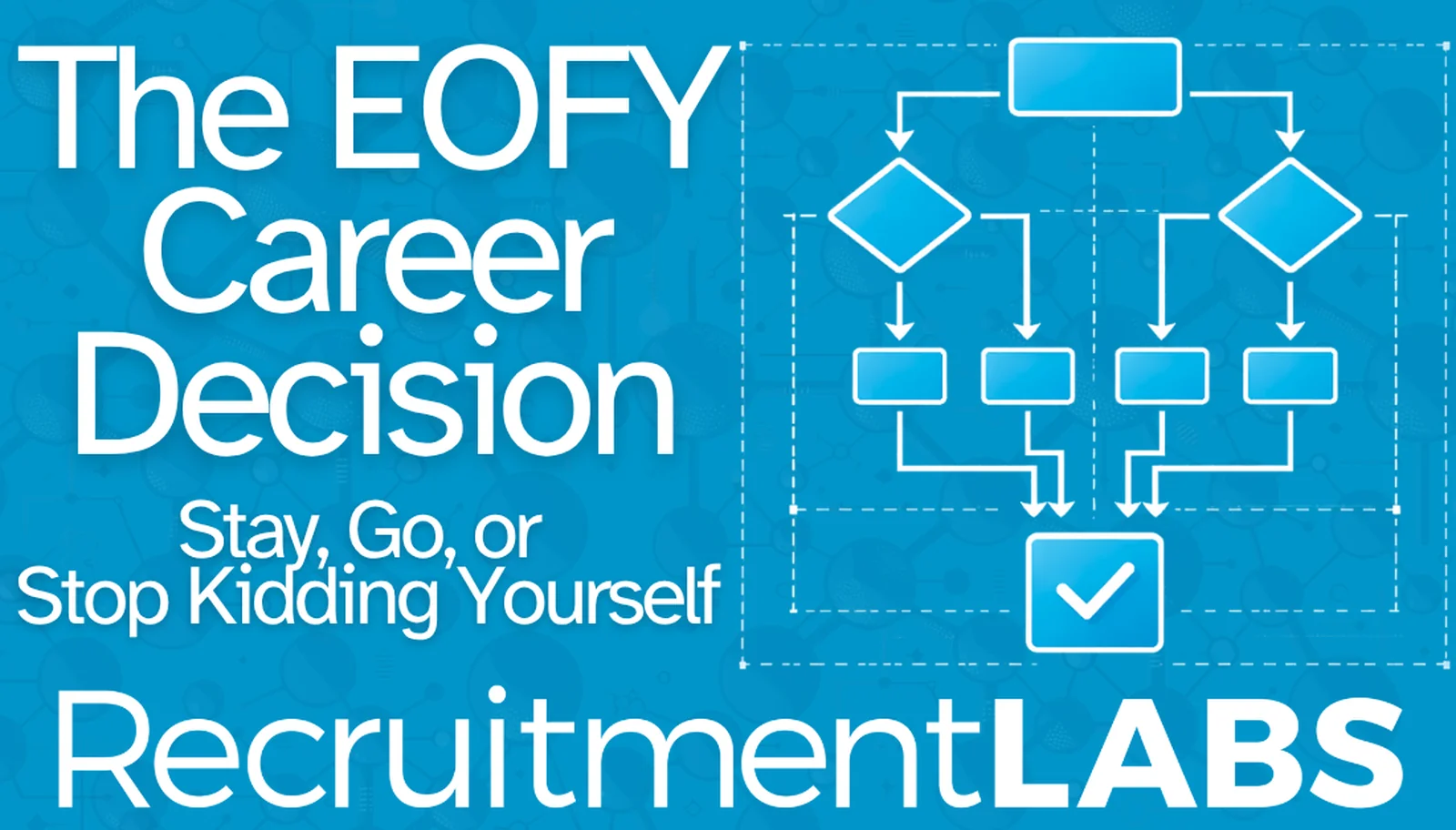
The EOFY Career Decision Stay, Go, or Stop Kidding Yourself
July 6, 2026 · 7 min read
Right about now, a significant number of finance professionals across Australia are sitting with the same quiet question.
The financial year is ending. Reviews have happened or are happening. Bonuses have landed or haven't. The new budget is being signed off and, somewhere in the margin of that conversation, someone is deciding whether your role is growing or staying exactly where it is.
And you're trying to work out whether any of it is enough to keep you here for another year.
This is the most consequential career moment most finance professionals face annually, and it tends to get made badly. Either too fast, on a wave of frustration after a review that didn't go the way you'd hoped. Or not at all — deferred, again, until the timing is better, the market is clearer, or you feel more certain.
Neither of those is a strategy.
The two ways this usually goes wrong
The first is the impulse decision. The review disappoints, the bonus underwhelms, or the promotion that was "almost certain" gets deferred for the third consecutive year. The frustration is real and often completely justified. But decisions made in that state tend to skip the actual analysis in favour of just needing things to be different.
The second is inertia dressed up as patience. "I'll see how the new year plays out." "The market feels uncertain." "I want to make sure I'm leaving for the right reasons." These are reasonable-sounding things that people say when the real issue is that moving is uncomfortable and staying is easier, at least for now.
Both patterns have a cost. The impulse mover sometimes lands somewhere worse and spends two years wondering why they were in such a hurry. The perpetual deferrer looks up at the end of another year and realises they've been saying the same thing since 2023.
What you're actually deciding
Most people frame this as a salary question. It is not, or at least not primarily.
Salary matters, and if you are being underpaid relative to the market that is a legitimate reason to move. But salary alone is a poor guide to whether you should stay or go, because it measures only one dimension of a decision that has several.
The more useful questions:
Scope. Is the role still growing, or has it settled into a steady state? Are you being given more complexity, more exposure, more genuine authority, or are you largely doing the same things you were doing eighteen months ago?
Trajectory. Where does this role credibly lead in the next two to three years? Not in theory, based on what someone said in your last review. In practice, based on what you have actually seen happen to people at your level in this business.
Leadership. Does the person above you make you better? Do you learn things in this environment, or are you largely operating on your own existing capability?
Market position. Is the experience you are accumulating making you more valuable externally, or is it increasingly specific to this one business? There is a version of seniority that opens doors, and a version that quietly closes them.
The honest read. If a recruiter called you tomorrow with a genuinely interesting opportunity, would your first feeling be excitement or relief? The answer to that question is often more useful than anything else.
Don't let the bonus make the decision for you
This is where a lot of people come unstuck.
The financial year closes in June, but for most finance professionals in larger businesses, the actual money comes later. Reviews get moderated, results get signed off by the board, and bonus payments typically land in August or September. That timing matters, because it means many people are making their "stay or go" call before they have the full picture — or deferring it entirely until the bonus arrives, and then letting the number make the decision for them.
When it lands and it is more than expected, or exactly what you hoped, the frustration of the past few months feels less sharp. The calculation shifts. You decide to stay.
That is not necessarily the wrong decision. But it is worth being clear about what the bonus actually represents. In some cases it is a genuine reflection of your contribution and the business's confidence in you. In other cases it is a retention mechanism, quietly designed to reset your twelve-month clock and get you through to the next review cycle without causing any disruption.
The question is not whether the bonus was generous. The question is whether anything has actually changed. Whether the scope is different. Whether the trajectory is clearer. Whether the conversation you needed to have has been had.
A good year financially in a role that is not moving is still a role that is not moving.
If you decide to move: the window is opening now
The July-August period is the most active finance hiring market of the year in Australia. New budgets are approved. Headcount gets signed off. Businesses that have been holding searches come to market. And the best candidates, the ones who are in demand and have options, tend to move in this window.
The ones who do well in it are not the ones who start thinking about their options in July. They are the ones who have done the thinking already. They know what they want, they have a clear narrative for why they are moving and what they are moving toward, and they are ready to engage properly when the right conversation comes along.
If you have done the analysis and the answer is genuinely that it is time to go, the next four to six weeks is a good time to start having conversations. Not firing off applications to everything that appears. Having deliberate conversations with people who understand your market.
There is a version of this that can be done while you are still employed, without drama, and without burning anything down. That is the version worth aiming for.
If you decide to stay: make sure it is a decision, not a default
Staying is completely legitimate. Sometimes the honest assessment is that the role is strong, the trajectory is real, and the right move is to double down rather than start again somewhere else.
But there is a meaningful difference between a negotiated stay and a passive one.
A negotiated stay looks like: you have done the analysis, you have had the conversation with your manager about what the next twelve months need to look like, and you have a clear picture of what you are working toward. The scope, the salary, the progression, the expectations. It is explicit and it is mutual.
A passive stay looks like: the bonus landed, the discomfort passed, and you decided to see how things go.
Both result in another year at the same place. But one of them puts you in a much stronger position twelve months from now, whether or not you are still there.
If you are staying, stay deliberately. Know why, know what you need to happen, and make sure the people who matter in the business know it too.
The question worth answering honestly
The end of the financial year creates a natural forcing function. Most people feel it, even if they do not always act on it.
The worst outcome is not making the wrong call. It is not making any call at all. Drifting through another July because the timing never feels quite right, the market never feels quite clear, and the decision never quite gets made.
The market is about to open. You have roughly the next four weeks to decide what you want your next year to look like, and to act on it properly while you still have the timing in your favour.
That is worth taking seriously.
About Recruitment Labs
Recruitment Labs is a boutique search firm specialising exclusively in accounting & finance recruitment across Australia and New Zealand. For twenty years we've helped businesses build high-performing finance teams, and helped finance professionals find roles that fit their skills, goals and values.
Keep Reading
More from The Hiring Horizon.

Your LinkedIn Is Your Second CV. A Finance Leader’s Profile Rebuild (Headline, About, Proof)
Most senior finance LinkedIn profiles run on default settings. A practical rebuild for Sydney and Australian finance leaders: headline, About section and proof.
Read Article
You’re Not Overqualified. You’re Mispositioned.
“Overqualified” is rarely honest feedback. Why senior finance candidates get filtered out for it, and the reframe that actually gets you the role.
Read Article
Some of the Best Candidates Move in July. Most Businesses Aren’t Ready.
July is when some of Australia's best finance candidates start moving. Here's why most hiring processes aren't ready to catch them.
Read Article