


The Hiring Horizon
You’re Not Overqualified. You’re Mispositioned.
July 20, 2026 · 6 min read
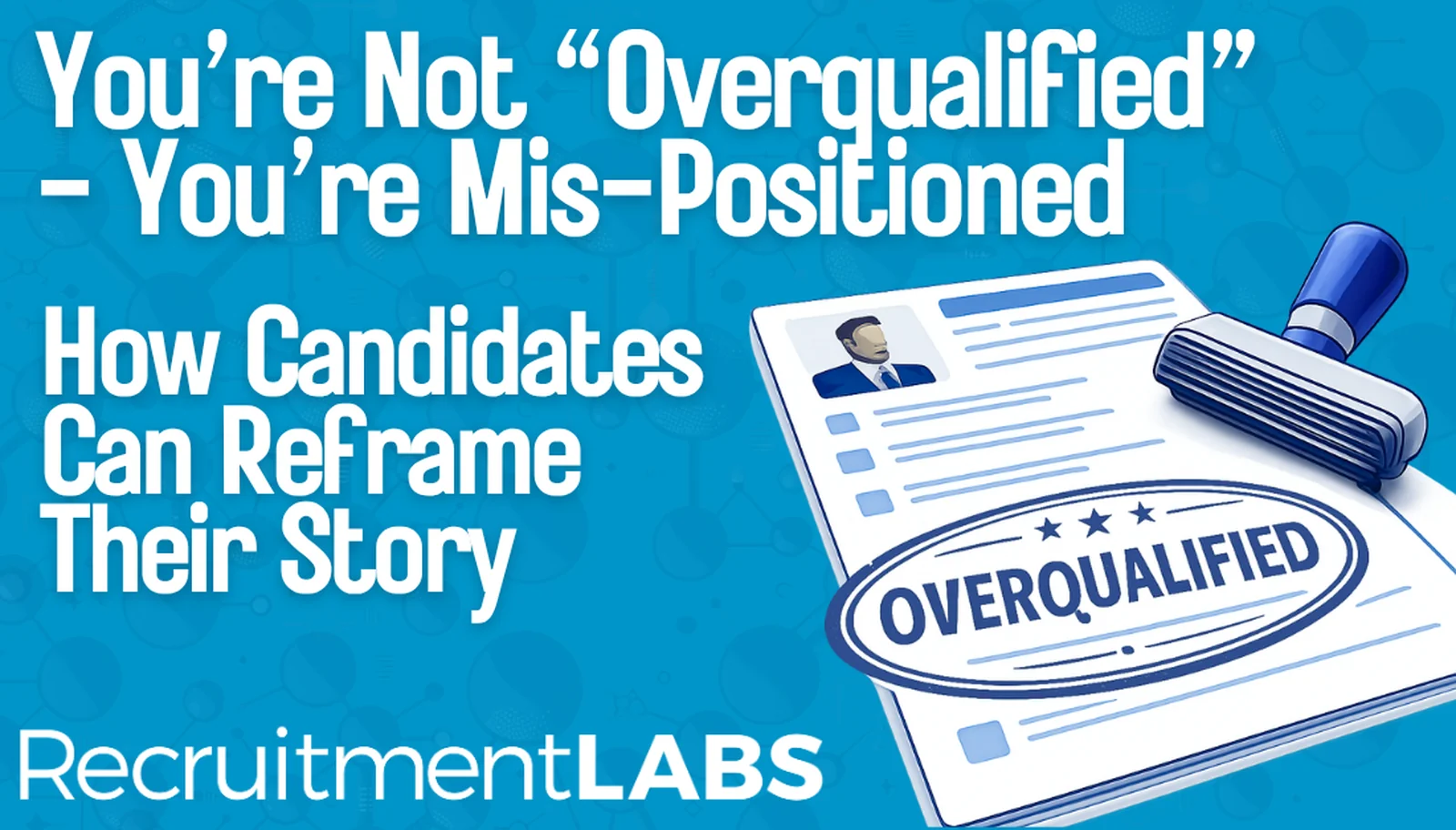
“Overqualified” is one of the most dishonest words in hiring. It sounds like a compliment on the way out the door, but it is almost never the real objection. It is what a hiring manager says when the actual concern is something they do not want to say out loud.
I see this constantly in senior finance hiring, and it is almost always fixable. Not by the candidate toning themselves down or apologising for their experience, but by naming the real concern before the client does, and answering it properly. Candidates who never get the chance to do that are the ones who lose the role to someone less capable but easier to explain.
What “overqualified” is actually code for
In fifteen years of running senior finance searches, I have never once heard a hiring manager reject someone because they had too much capability. That is not a real problem. What sits underneath the word is usually one of four things.
Flight risk. They assume you will leave the moment something bigger comes along, and they do not want to run this process again in eight months.
Disengagement. They worry the role will bore you within a quarter and you will coast, or worse, become the person quietly undermining decisions from a level below.
Power and ego. They are picturing you challenging their authority, unsettling the team’s reporting lines, or struggling to take direction from someone with less experience than you.
Cost. Your salary history suggests expectations they cannot meet, and rather than test that directly, it is easier to file you under “overqualified” and move on.
None of these are irrational. They are legitimate risks a hiring manager is entitled to weigh up. The problem is that “overqualified” lets them avoid testing whether the risk is actually real.
The process rarely gives you a chance to answer it
Here is the part that is on us as much as the candidate. Most interview processes are not built to surface this concern, only to quietly act on it.
A hiring manager forms the “overqualified” view early, often from a CV skim before the first conversation has even happened. It rarely gets said aloud. It shows up instead as a shortlist that mysteriously does not include you, or an interview that feels warm but goes nowhere. The candidate is left guessing, and the business never actually tests whether the concern was true.
This is a process failure more than a candidate failure. A well-run process surfaces the real question directly, in the room, where it can be answered. A poorly run one lets it sit unspoken and quietly decides the outcome anyway. If you are on the hiring side reading this: ask the question. Directly. “Help me understand why this scope, at this stage of your career.” You will learn more from thirty seconds of a straight answer than from three weeks of second-guessing a CV.
If you are the candidate, you cannot always rely on being asked. You have to answer the question before it gets asked, or before it gets decided without you.
The reframe that actually works
The goal is not to convince anyone you are humble. Humility is not the issue, and trying to perform it usually reads as false. The goal is to convince them this is a deliberate, considered choice, not a step you are settling for.
That means being specific on three things: why this scope suits you now, not “I’m open to it” but the actual reason this remit is where you do your best work; what genuinely anchors you here, whether that is the industry, the leadership team, the runway, or simply wanting depth over hierarchy for a while; and why the business wins, which usually comes down to senior judgement without the ramp-up time a less experienced hire would need.
Said plainly, it sounds something like this: “I’m being deliberate here. I did the bigger-team, bigger-title version of this role and learned it wasn’t where I do my best work. I’m looking for depth, a clear mandate, and a team I can actually be hands-on with.” That is a confident answer, not a defensive one, and hiring managers can tell the difference immediately.
Proof beats reassurance
Words alone will not close this out. Anyone can say they are grounded. What actually moves a hiring manager is evidence that you still want to be in the detail.
Talk about the system you fixed yourself rather than delegated. The messy reconciliation you owned personally. The stakeholder problem you solved through influence rather than title. If you have a genuine personal reason for the trade-off, whether that is location, industry, or simply wanting to build something again from the ground up, say so plainly. Specifics land. Reassurance does not.
I saw this play out recently with a candidate who had been internally promoted into a Financial Controller role, managed a team of fifteen, and a year later realised the leadership side was not where she wanted to be. She applied for a senior accountant role reporting into an FC. The obvious objection was that she would be bored within a term. What actually got her the job was a very direct answer: she had learned, in the FC seat, that she was strongest as the technical second-in-command solving hard problems, not managing an army, and she said so without hedging. The clarity was the thing that worked, not the justification.
If compensation is the real issue, treat it like one
Sometimes “overqualified” is genuinely about money, and pretending otherwise wastes everyone’s time. If your expectations sit above the role’s band, that is worth surfacing early and directly rather than letting it surface later as an awkward offer conversation. If you are willing to trade some salary for scope, flexibility, or a shorter commute, say so with a reason attached. A logical trade-off reads as considered. An unexplained one reads as desperation, and hiring managers notice the difference.
When it is not positioning, it is a genuine no
Not every “overqualified” is a solvable objection, and it is worth being honest about that too. Some signs it is a real no rather than a fixable one: they keep circling the word without naming a specific concern you could actually address, they want senior-level accountability but are only prepared to offer junior-level authority, or the term is being used to justify an offer that is well under market. None of those improve with a better script. They are worth walking away from.
The takeaway
“Overqualified” is not a diagnosis. It is a positioning problem, and mostly it is a process problem, an unspoken concern that never gets tested properly in either direction. Fix the story, bring the proof, and you turn a soft no into a genuine yes. Or, just as usefully, you find out early that it was never really about your CV at all.
At Recruitment Labs, we tend to see the best outcomes when senior candidates address the unspoken concern directly rather than waiting to be asked. If you are being filtered out for being “too experienced” for roles you actually want, it is usually a five-minute conversation to fix, not a five-month job search.
About Recruitment Labs
Recruitment Labs is a boutique search firm specialising exclusively in accounting & finance recruitment across Australia and New Zealand. For twenty years we've helped businesses build high-performing finance teams, and helped finance professionals find roles that fit their skills, goals and values.
Keep Reading
More from The Hiring Horizon.

Your Career Narrative: 3 Things to Bed Down before interviewing in 2026.
Three things to bed down in your career narrative before interviewing in 2026, so you can tell a clear, credible story.
Read Article
Brief Me Like I’m the Candidate: How to Really Assess a Recruiter
The best test of a recruitment partner isn’t their process or their fee. It’s whether they can brief you on the role as if you were the candidate.
Read Article
Your LinkedIn Is Your Second CV. A Finance Leader’s Profile Rebuild (Headline, About, Proof)
Most senior finance LinkedIn profiles run on default settings. A practical rebuild for Sydney and Australian finance leaders: headline, About section and proof.
Read Article